
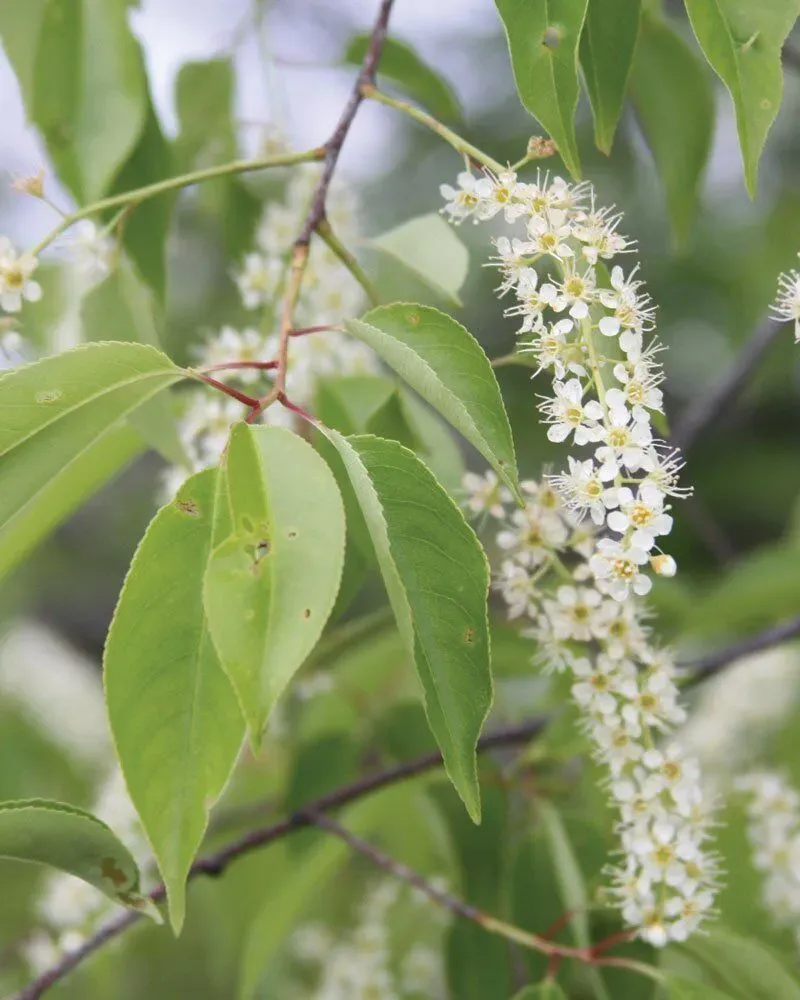

The leaves, twigs, bark, and seeds are poisonous to livestock and household pets like cats or dogs. These parts of the tree contain a cyanogenic glycoside which releases hydrogen cyanide when chewed or digested.
The fruits are an important food source for several species of birds including the Brown Thrasher, White-throated Sparrow, Northern Cardinal, Scarlet Tanager, Song Sparrow, Rose-breasted Grosbeak, Baltimore Oriole, Common Grackle, House Finch, Gray Catbird, American Robin, Swainson’s Thrush, Veery, Eastern Bluebird, Red-eyed Vireo, European Starlings, Eastern Towhee, Cedar Waxwings, Northern Mockingbird, Eastern Kingbird, Northern Flicker, Yellow-bellied Sapsucker, Downy Woodpecker, Pileated Woodpecker, Hairy Woodpecker, Red-bellied Woodpecker, Red-headed Woodpecker, Ruffed Grouse, Pheasant, Greater Prairie Chicken, Wild Turkey, Bobwhite Quail, and American Crow.
Black Cherry is a larval host plant for many a staggering number of moths and butterflies. This is just a sampling: Small-eyed Sphinx (Paonias myops), Scalloped Sallow (Eucirroedia pampina), Wild Cherry Sphinx (Sphinx drupiferarum), Tortricidia flexuosa, Cherry Shoot Borer (Argyresthia oreasella), Ultronia Underwing (Catocala ultronia), Eastern Tiger Swallowtail (Papilio glaucus), Splendid Dagger moth (Acronicta superans), Bethune’s Pinion (Lithophane bethunei), Great Leopard moth (Hypercompe scribonia), Speared Dagger (Acronicta hasta), White Furcula (Furcula borealis), Ferguson’s Scallop Shell (Rheumaptera prunivorata), Spotted Apatelodes (Apatelodes torrefacta), Tufted Bird-dropping Moth (Cerma cerintha), Skiff Moth (Prolimacodes badia), Hag Moth (Phobetron pithecium), Spiny Oak-slug Moth (Euclea delphinii), Hummingbird Clearwing (Hemaris thysbe), Luna Moth (Actias luna), Io Moth (Automeris io), Lunate Zale (Zale lunata), Purple-crested Slug Moth (Adoneta spinuloides), Woody Underwing (Catocala grynea), Cecropia Moth (Hyalophora cecropia), Crocus Geometer (Xanthotype sospeta), Bent-line Gray (Iridopsis larvaria), Funerary Dagger (Acronicta funeralis), Bluish Spring Moth (Lomographa semiclarata), Harris’s Three-spot (Harrisimemna trisignata), Elegant-tailed Slug Moth (Packardia elegans), Lemon Plagodis Moth (Plagodis serinaria), Common Idia Moth (Idia aemula), Checkered-fringed Prominent (Schizura ipomaeae), Peppered moth (Biston betularia), Red-spotted Purple (Limenitis arthemis), Coral Hairstreak (Satyrium titus), and Honest Pero Moth (Pero honestaria).
Price is for 1 tree | #5 Container
Height: 50' - 60' | Spread: 25' - 35'
Easily grown in average soils with medium moisture levels.
We envision a day when knowledge of birds is widespread, decisions affecting them are based on good science, and citizens care about conservation and participate in it so that common species are kept common and imperiled populations are restored.