
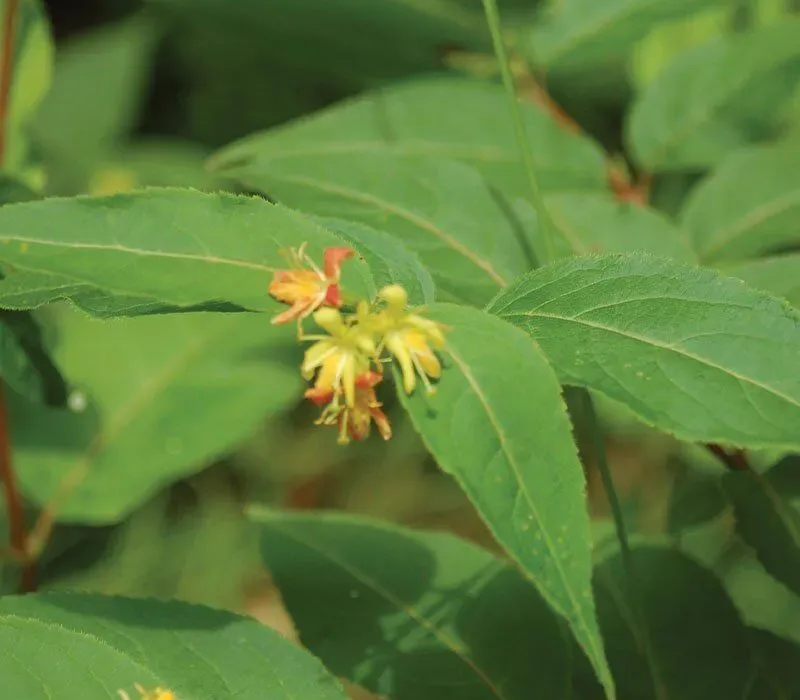

Dwarf Bush honeysuckle is a Wisconsin native landscape plant noted for its shrubby form, spreading habit, yellow trumpet-shaped flowers, and brilliant fall color. New foliage emerges in unusual tints of coppery green and bronze. The growth of new stems appears with a crimson tint. The complexity of colors is especially appealing when the Bush honeysuckle flowers. Small greenish-yellow buds appear in early June and open later in the month drawing in pollinators from far and wide.
In early summer, pairs and trios of yellow, tube-like flowers provide a feast for nectar-seeking insects as well as hummingbirds. The floral banquet benefits butterflies, green sweat bees, leafcutter bees, and hummingbird moths, but the most important pollinators are bumblebees. Visitors include the Rusty-patched Bumblebee (Bombus affinis), Golden Sweat bee (Augochlorella aurata), Yellow-banded Bumblebee (Bombus terricola), Half-black Bumblebee (Bombus vagans), Orange-tipped Wood-digger bee (Anthophora terminalis), Megachile inermis, Peck’s Skipper (Polites peckius), and Orange Sulphur (Colias eurytheme). It is a host plant for the Snowberry Clearwing (Hemaris diffinis), Laurel Sphinx (Sphinx kalmiae), and Diervilla Clearwing (Hemaris aethra).
During winter, deer and moose are known to browse twigs and stems. In most cases, this will encourage branching and flushes of new growth. Thickets of the Dwarf Bush honeysuckle provide a nice, sturdy shelter for ground-nesting birds such as Killdeer, Timberdoodle, and Wilson’s snipe. Sharp-tailed Grouse also consume the buds and find cover within the shrub.
The fruit capsules persist to early winter and are desirable to many songbirds and other low-foraging critters.
Price is for 1 shrub | #2 or #5 Container
Plant spread: 2'-3'
Bloom: June-August | Height: 3' | Medium-dry, Dry
Plant Description and photos provided by Johnson's Nursery
We envision a day when knowledge of birds is widespread, decisions affecting them are based on good science, and citizens care about conservation and participate in it so that common species are kept common and imperiled populations are restored.