
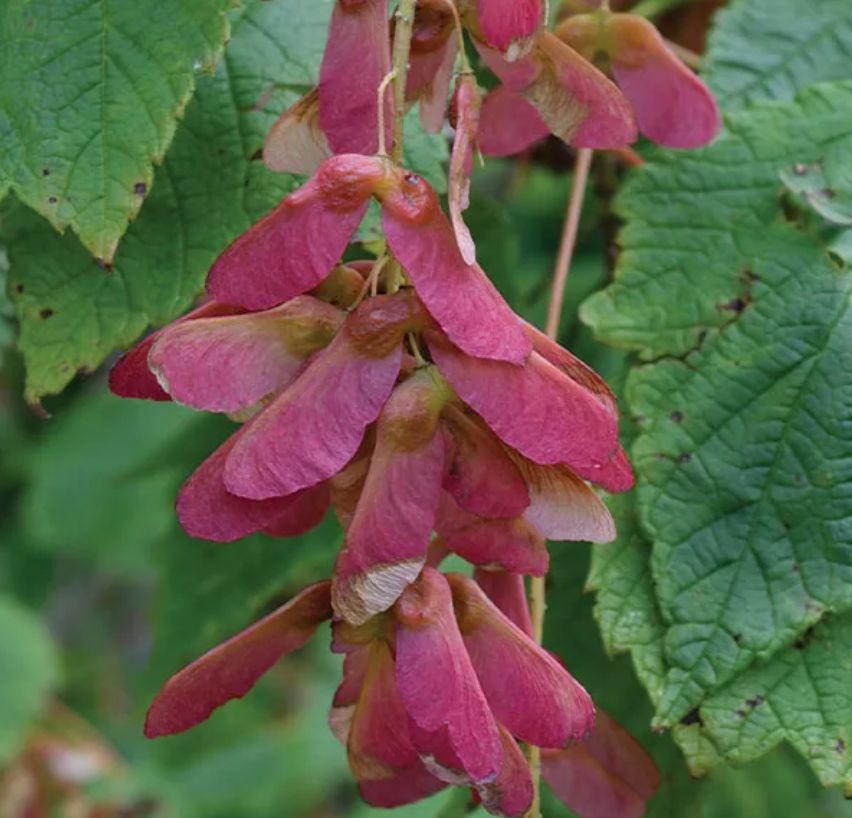

Mountain Maple is naturally found in northern Wisconsin where the soil is moist, loamy, cool, and acidic. It can, however, adapt to clay and may do well in southern Wisconsin if it is sited in an area with cool, moist soil.
Restoration and Erosion Control: Mountain Maple is often found along rivers and stream banks. When left to do their thing they can grow an extensive, shallow root system. The ends of stems are capable of putting down roots when they come in contact with the ground. These new roots can send up shoots, creating a thicket along the stream providing erosion control, shade, shelter, and food for wildlife. Mountain Maple has been observed to grow aggressively in disturbed forests in Door County, covering bare ground and providing shelter and food for wildlife.
Landscaping: Mountain Maple sports small, white-flowered racemes in the spring, classic maple leaves and shade in the summer, as well as stunning fall color. It tends to grow in a multi-stem form that rarely reaches 30 feet tall, especially when browsed by deer, so unless it is protected then do not expect it to have a classic maple tree shape. Mountain Maple is a great choice for a homeowner looking for a natural-looking, native, flowering multi-stem tree.Mountain Maple is a small, hardy, understory tree native to Northern Wisconsin that is often found in woodlands, along streams, rivers, lakes, and on rocky, northern-facing slopes. Small white flowers appear on spikey racemes in spring, followed by red samaras and then in autumn, outstanding fall color that ranges from clear yellow to bright orange to scarlet red. The leaves can be differentiated from most other maples’ by their shallow lobes of which there are only three, as opposed to five lobes on most other maples. This tree is a good for planting on steep slopes and stream banks as it helps prevent erosion.
The bark is preferred by White-tailed Deer, beaver, rabbits, and moose. So much so that the tree is also called Moosewood or Moose Maple. When browsed, Mountain Maple grows back with renewed vigor. This has a two-fold benefit of keeping the tree small so that the more plentiful, palatable young shoots can be reached by the animals who feed on it. Due to its renewed growth after pruning/browsing it is considered deer resistant.
Price is for 1 tree | #5 Container
Height: 20-35' | Bloom: March-May
Soil: Prefers well-drained soil and can grow in heavy clay soil.
Photos and description from Johnson's Nursery
We envision a day when knowledge of birds is widespread, decisions affecting them are based on good science, and citizens care about conservation and participate in it so that common species are kept common and imperiled populations are restored.