
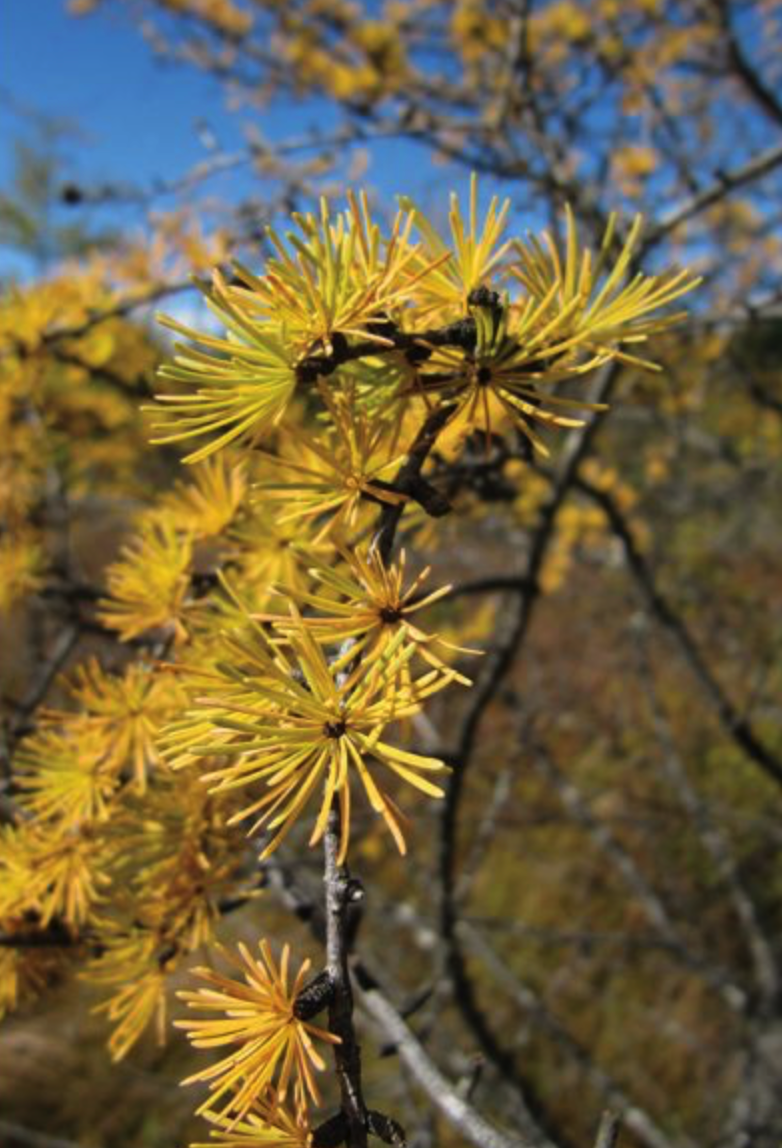

Tamarack is a Wisconsin native deciduous conifer. Unlike most evergreens and conifers, the Tamarack tree loses its needles each winter season. It possesses a narrow, open conical form with horizontal branching and drooping secondary branchlets. The soft, bright blue-green foliage turns a rich golden-yellow in fall. A great choice for wet sites!
White-Throated Sparrow, Song Sparrow, Veery, Common Yellowthroat, and Nashville Warbler all benefit from Tamarack trees, whether for food or cover. Lowland Tamarack stands are a habitat to Ospreys and the Great Gray Owl farther north. Spruce Grouse and White Winged Crossbill use Tamarack as a food source in winter. During the growing season, keep an eye out for the native Columbia Silkmoth larvae.
Although adaptable, Tamarack is not tolerant of prolonged drought due to its shallow, spreading root system. A consistent mulch ring around the base will help retain moisture, and the tree should be watered when less than one inch of rain is received per week.
Click here for more information!
#1 or #5 container
Height: 30'-50' | Spread: 10'-15' |
Adaptable to many soils, drought intolerant
We envision a day when knowledge of birds is widespread, decisions affecting them are based on good science, and citizens care about conservation and participate in it so that common species are kept common and imperiled populations are restored.